BMS Readout PCA Redesign
Update 11/20/2025
Arduino just released a new version of the Nano, the Nano-R4 based on the Renesas RA4M1 32-bit Arm® Cortex-M4 processor. The Nano-R4 is pictured below:
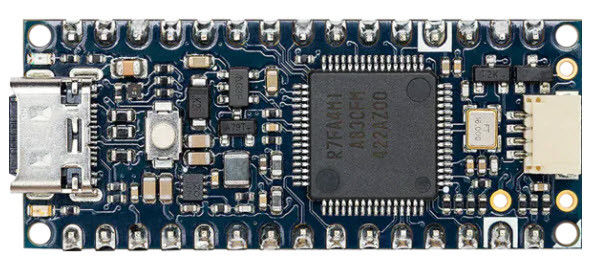
It has the same 256kB Flash and 32kB RAM of the Nano 33 IOT. What is unique about this board is that it has a +5V operating voltage. The I/O, including I2C is at +5V so it removes the need for logic-level shifters and I2C line drivers. It even includes a QWIIC connector, which per the specification of QWIIC, the I2C is at +3.3V, so it would also work with the 3.3V RTC and SD Card. The board has built-in logic level translators to convert the +3.3V I2C to +5V for the microprocessor. The only issue there might be: will all the code for the BMS reader compile to run on the Renesas microprocessor. Probably what I will find is that the reader program will compile for that processor, but take considerably more time to compile, just like the other non-SAMD21 Nano processors I tested.
Learn more about the Nano-R4 here.
Update: 11/26/2025
I received a sample of the Arduino Nano-R4. I found that it compiles in about the same time as the Nano-33 IOT that I am using on the BMS Reader but it takes 10% more of the amount memory in use, both program size and dynamic memory. Probably because of the additional code required to run the Renesas processor with ATMIL (SAM) code. The Nano-R4 is more of a curiosity than something I would implement. Like the ESP32 that I reviewed in a previous blog (here) it has a CAN BUS serial interface so I could eliminate the MCP2515 CAN BUS controller. But to use this feature along with the other unique features of this board I would have to design and fabricate a new PCB. Probably something I will not do, for now.